A fleet of resolution agents that runs your SAP support queue.
TesseraOps is one system with three parts. A fleet of agents that learn each client's SAP and resolve tickets across ServiceNow and SAP. A governed runtime that gates every action by risk, so nothing higher-risk touches production without a human, re-reads the system after every change, and keeps a per-ticket record of what was done. And an assessment that maps the queue and proves the savings against your own data.
01
The fleet
Agents own slices of the queue and carry that client's functional SAP knowledge: the processes, the configuration, the recurring failures.
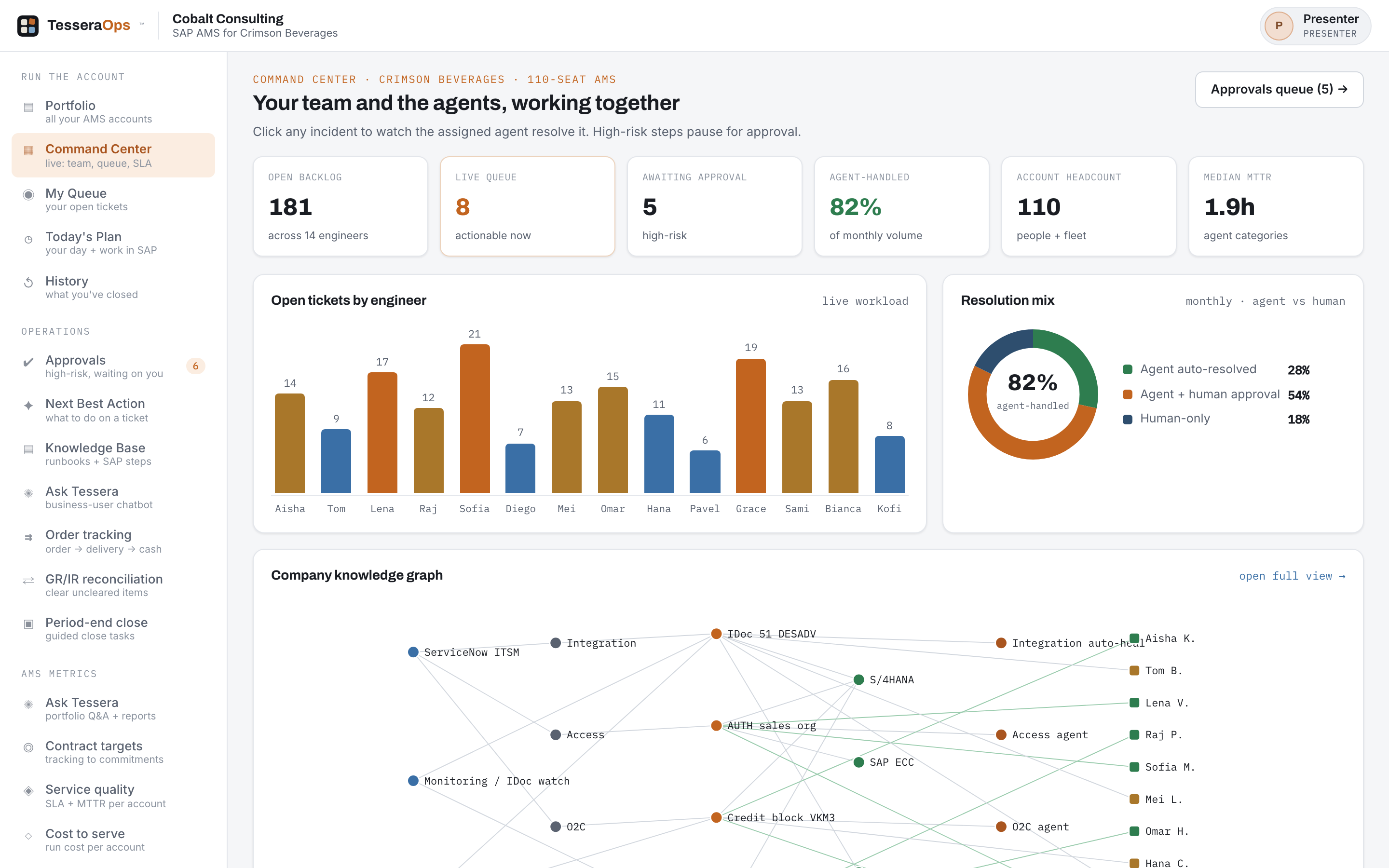
↓ Command Center
02
The governed runtime
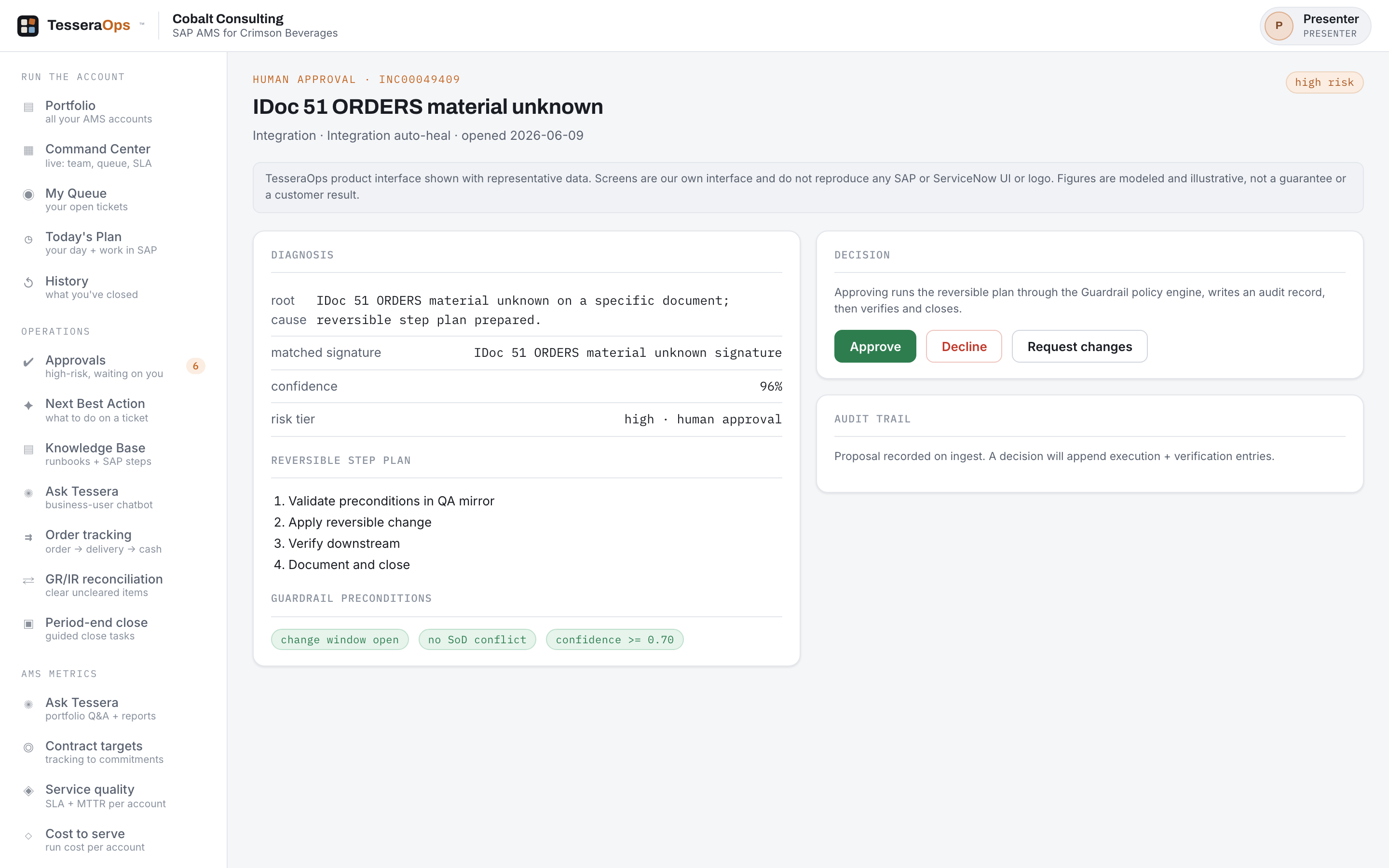
Every proposed action passes a deterministic policy engine, decided by the engine rather than the model. Higher-risk work waits for a named person. After the change, the source system is read again to prove it worked.
↓ Human approval
03
The assessment
The read-only starting point: a taxonomy, scored automation candidates, and a savings model built from your own history.
↓ Assessment
Here is what that looks like in the product. Follow one ticket end to end
These are screens from the TesseraOps product, captured with representative data. They reference SAP transactions (for example BD87, WE20, SU01, SM37) and ServiceNow incident records so they are credible to practitioners. They do not reproduce SAP or ServiceNow interfaces, screens, or logos.
01 · Command Center · where the fleet works your queue
The team and the agents working the queue together, with live SLA, cost-to-serve, and resolution mix.
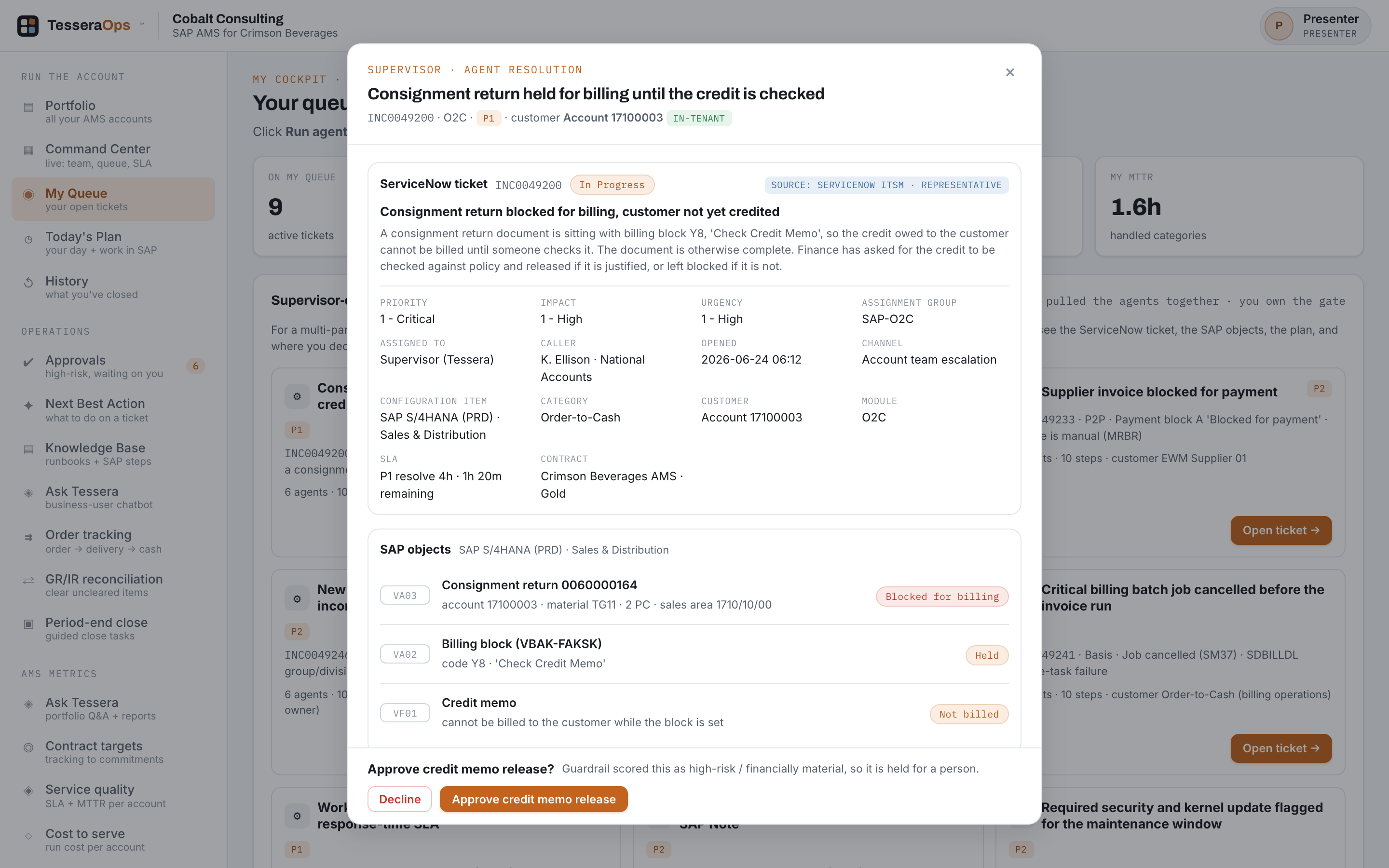
02 · Triage and diagnose · a supervisor pulls the right agents onto one ticket, read-only
The supervisor reads the ticket, selects the specialists, and each returns a structured finding. Here the guardrail has scored a credit release as financially material, so it stops and waits.
03 · Act with your approval · nothing higher-risk ships without a sign-off
The agent proposes a reversible plan; the guardrail engine checks it; a person approves before anything runs. Every step is on the record.
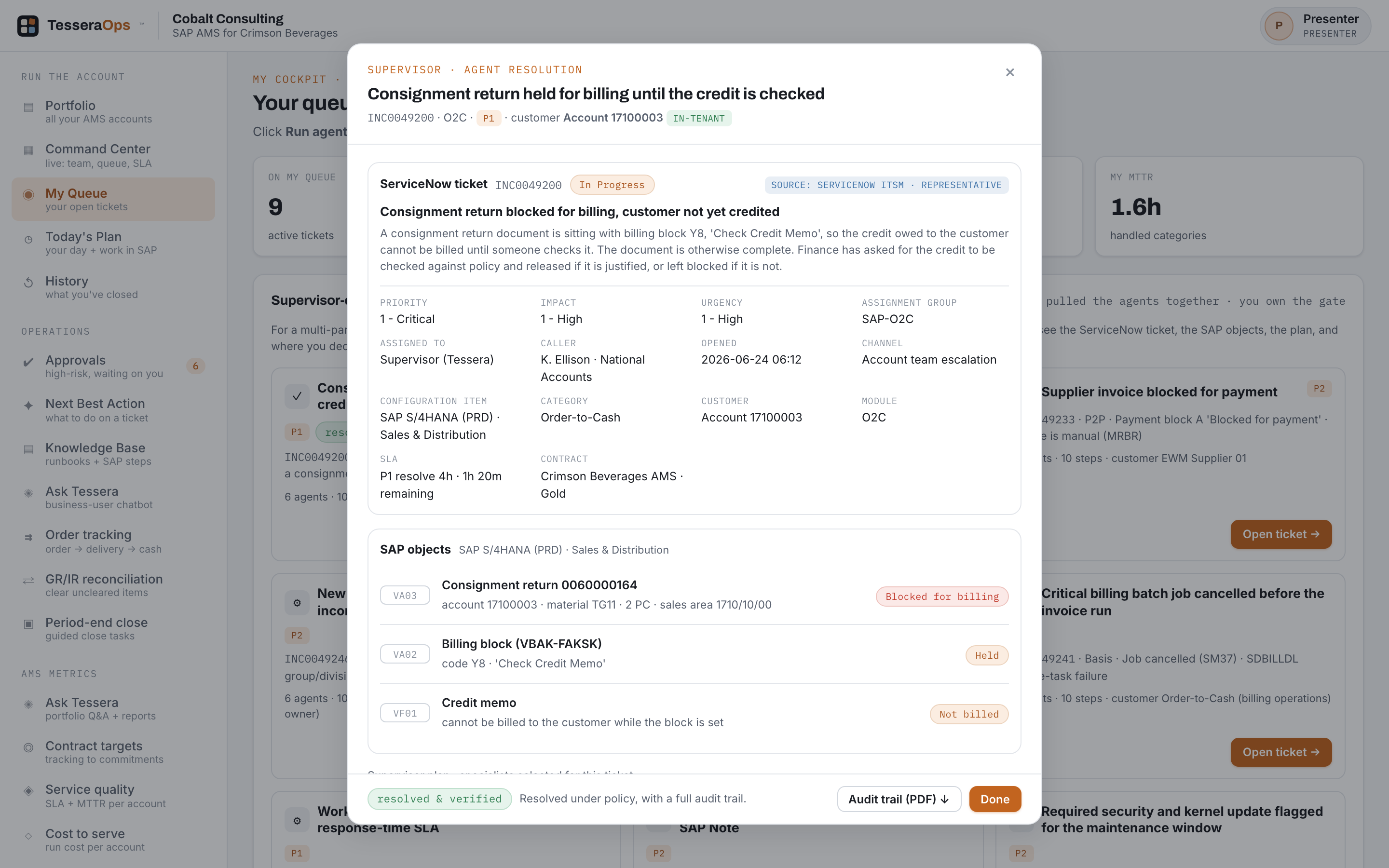
04 · Verified, then closed · the system is read again to prove it
A write is not a resolution. After the change the source system is read back independently, and unverified is treated as unresolved. The record for each ticket exports on its own: the agent sequence and timings, the policy decision, the approver, the interfaces called, and the tables read and written.
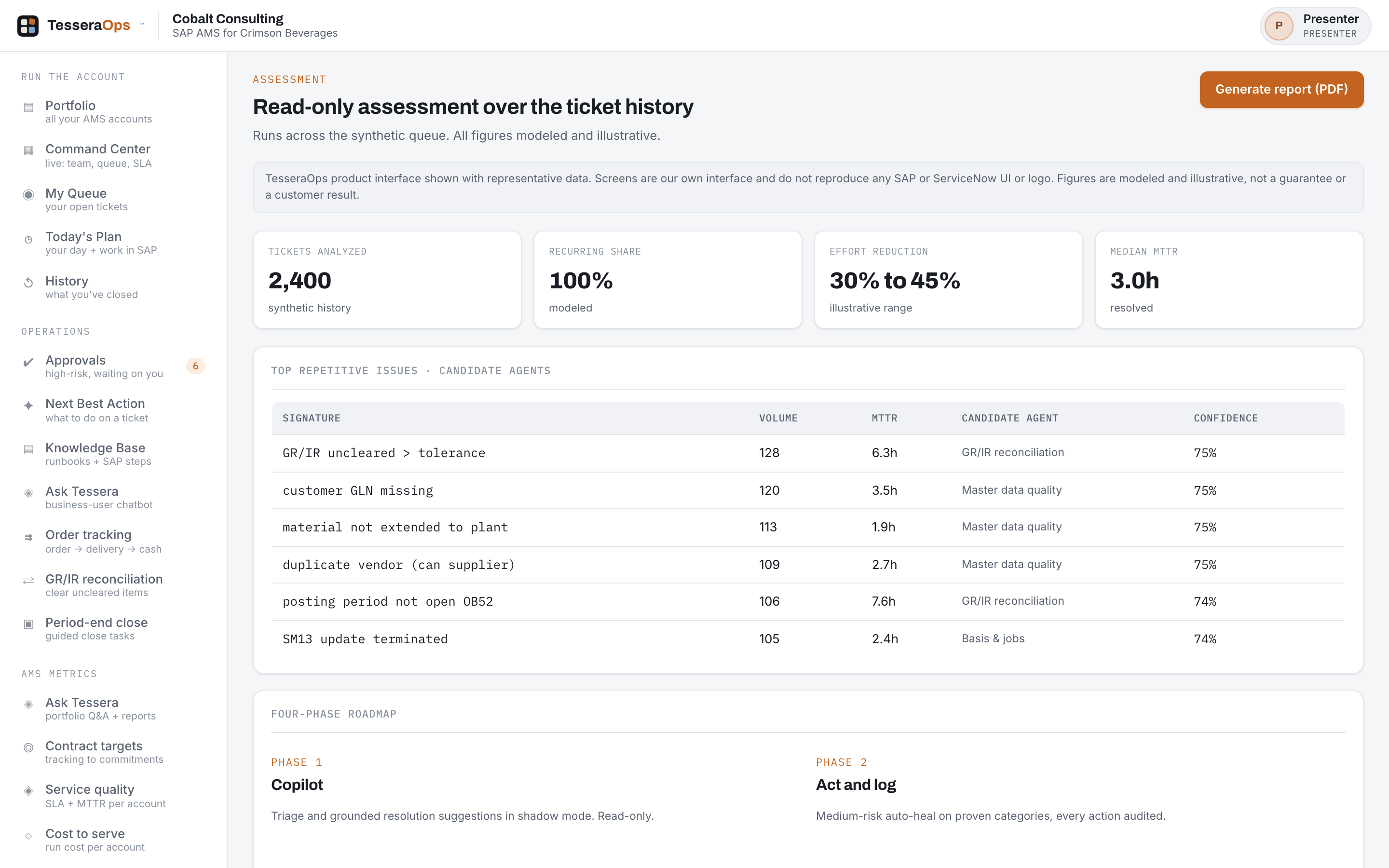
05 · Assessment · the savings, measured against your own data
Read-only over your ticket history: top repetitive issues, candidate agents with confidence, and a modeled effort-reduction range. Figures are targets, not guarantees.
See it on your data
These screens use representative data. Your assessment would not.
Request an assessment and we will run this against your own history.